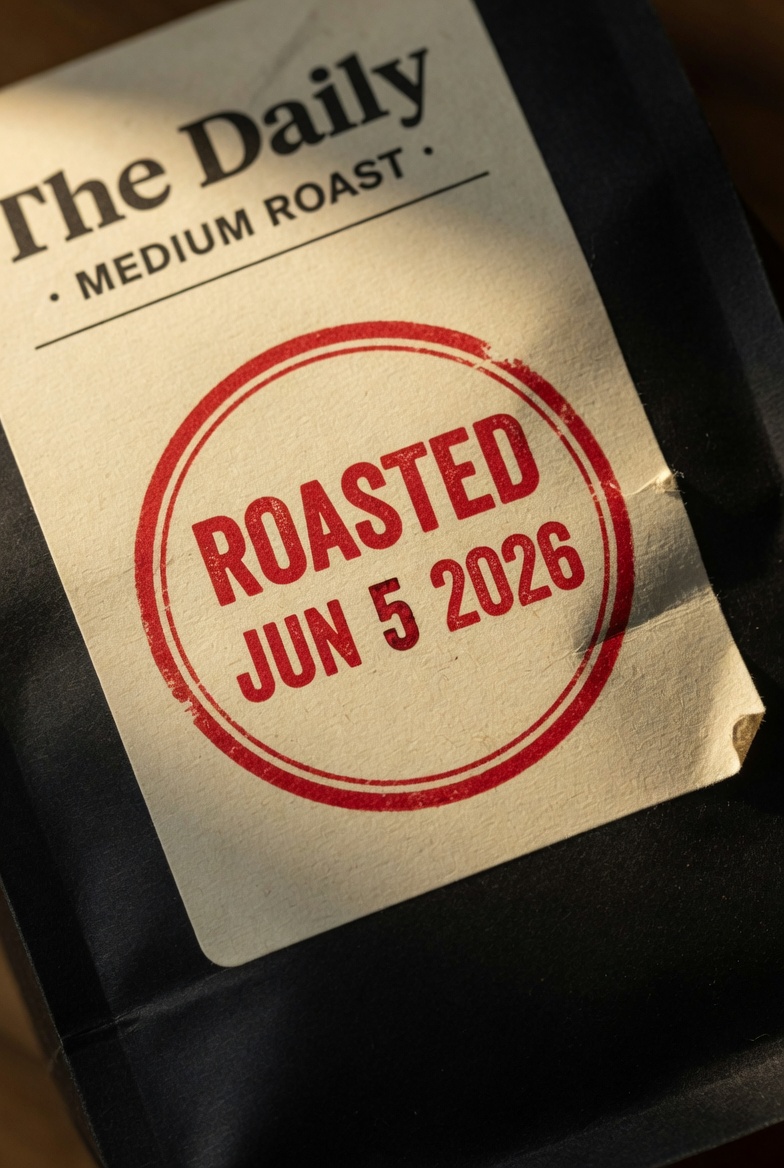
Roast date vs. "best by," what the 30-day window means, how to store coffee without ruining it, and why grocery-shelf coffee is functionally a different product. 5 minutes.
Three things happen to roasted coffee in the days after it leaves the roaster, none of them good for your cup.
1. CO2 escapes. Roasting releases a lot of carbon dioxide inside each bean. For 5-7 days after roasting, beans actively "degas" — that's why bags have a one-way valve in the seam. Fresh coffee actually brews too aggressively for the first few days (the CO2 disrupts even extraction). Then it stabilizes. Then it just keeps leaving.
2. Volatile aromatics dissipate. The compounds that make Ethiopia smell floral and Sumatra smell smoky are literally evaporating from the bean. By day 30, you've lost about 40% of them. By day 60, more than half. This is the single biggest reason old coffee tastes flat — not bitter, not bad, just less.
3. Oxidation. Coffee oils on the bean's surface react with oxygen. Light roasts oxidize slower (less surface oil); dark roasts oxidize faster (more oil migrates to the surface during roasting). Oxidized oils taste a bit cardboardy. It's subtle, but it's the difference between "good" and "off."
What your bag actually tastes like, by week:
If a bag has a roast date, the roaster wants you to know how fresh it is. If a bag only has a "best by" date — usually 12 to 24 months in the future — that almost always means the roast date is too unflattering to print. Do the math: a bag with a "best by" of December 2027 was probably roasted in December 2025. That's 24 months old by the time you taste it.
This is the easiest filter in the coffee aisle. Bags with a roast date are usually fresh enough to matter. Bags without one usually aren't. There are exceptions, but they're rare.
This is also why our standard is the roast date on every ShopCoffee bag. The number isn't decoration — it's the actual fact we want you to use.
Sealed. Keep coffee in its original bag (with the one-way valve sealed back up) or in an airtight opaque container. Glass jars on the counter look great and accelerate staling — light is one of the things you're protecting against.
Cool, not cold. Room temperature in a dark cabinet is fine. The fridge is a bad idea — coffee absorbs odors and the temperature swings every time you open the door cause condensation inside the bag, which is the worst possible thing for beans.
The freezer is controversial. The honest answer: freezing whole bean coffee in airtight portions you don't open until you brew them works. Freezing a whole opened bag and pulling beans from it twice a day will ruin it via repeated thaw/refreeze condensation. If you're going to freeze, freeze in pre-portioned sealed bags and treat each one as one-shot. Otherwise skip it.
Whole bean only, until you brew. Pre-ground coffee oxidizes about 5x faster than whole bean because of the surface area. Grind 30 seconds before you brew, every time. A $40 burr grinder is the highest-ROI coffee equipment purchase you can make.
Decaf isn't immune. The decaffeination process actually leaves decaf slightly more vulnerable to staling than regular coffee — less oil but more porous bean structure. Treat it the same way: roast date, ~30 day window, sealed and dark.
Cold brew concentrate stays good longer. Brewed cold brew (in the fridge, sealed) is good for 2 weeks. Once diluted, 3–4 days. The brewing process strips out the volatile aromatics that go off first, so what's left is more stable.
Espresso wants slightly older beans. Most espresso bars rest beans 5–10 days before pulling shots. Super-fresh beans extract unevenly because of degassing. If you're pulling espresso at home, give a new bag a few days before judging it.
"Vacuum-sealed bricks at the grocery store are fresh." The vacuum prevents further oxidation, but it doesn't undo the staling that happened between roasting and packaging — which for grocery brands is typically weeks. The brick technique extends shelf life so the product is still drinkable a year later, not so it's fresh.
"Oily beans on the outside means dark roast and that's fine." Oily beans mean two things: it's a dark roast (true), and the oils are oxidizing in real time on the bean's surface. Dark roast freshness windows are shorter than light roast, not longer. Drink them faster.
"You can taste freshness." You can taste the difference between fresh and stale once you've tried both within a couple weeks. Most people who've only ever had grocery coffee don't know what they're missing because they have no reference point. The fastest way to learn is to buy one fresh-roasted bag and compare it side-by-side with whatever's currently on your counter.
Three rules, baked into how the business works:
Whole-bean coffee is at its best from about 4 days to 4 weeks after the roast date. It needs a few days to release CO₂ (degassing), hits its peak around days 7–21, and then slowly fades. Ground coffee stales far faster — aim to drink it within 20–30 minutes of grinding, which is why a burr grinder is the upgrade that changes the most.
A roast date tells you exactly when the coffee was roasted, so you can judge freshness yourself. A "best by" date tells you when the seller estimates the coffee is no longer sellable — often 12+ months out — which says nothing about peak flavor. A roast date is a sign of a roaster with nothing to hide; a "best by" date usually means the coffee is old enough that a roast date would be embarrassing.
Coffee doesn't become unsafe to drink for a very long time — it's not going to make you sick. But it goes stale: the aromatic oils that carry most of the flavor oxidize and evaporate within weeks. Stale coffee is flat, cardboard-y, and dull rather than dangerous. So it doesn't "expire" in a food-safety sense; it just stops being good coffee.
Not the fridge — it's humid and full of odors coffee readily absorbs, and every open-and-close cycle causes condensation on cold beans. For beans you'll drink in the next month, keep them in an airtight, opaque container at room temperature, away from heat and light. The freezer only helps for long-term storage of beans you won't touch for months, sealed in airtight portions and never re-frozen.
Once opened, aim to finish a bag within about 2–3 weeks for whole bean. The one-way valve on a good bag lets CO₂ out without letting oxygen in, but once you break the seal the clock speeds up. Buy in quantities you'll actually drink in that window rather than stockpiling.
Whole bean, by a wide margin. Grinding multiplies the coffee's surface area, so ground coffee stales roughly five times faster. Buy whole bean and grind right before you brew — see our brewing guide for grind sizes by method.